Spectadors

Categories
Blog

Thor Video Prompt

Use the uploaded start frame as the exact opening frame and the uploaded end frame as the exact final frame. Use the reference video only for the hammer’s kinetic flight and close camera-follow movement.

Create one continuous 5-second photorealistic shot. The hammer briefly vibrates on the planter, its strap flutters, then it lifts vertically into the air before accelerating forward.

The hammer must fly high through the visible open gap between the tree foliage on the left and the apartment building on the right. Do not make it travel low, slide along the ground or drift sideways. The flight path should be: rise upward, fly through the centre gap between the tree and building, then curve downward toward the woman standing on the footpath.

The camera stays tightly locked behind the hammer throughout, keeping it centred while following the same fast kinetic movement as the video reference. Use smooth acceleration, strong depth, foreground parallax and natural directional motion blur.

Preserve the hammer exactly: same grey metallic head, orange handle, fabric strap, size, shape, textures and colours. No redesign or uncontrolled spinning.
The woman must remain exactly identical to the uploaded end frame: same face, hairstyle, skin tone, body shape, brown top, blue jeans, white shoes, expression and proportions. She is already standing in the exact wide-legged pose shown in the end frame.

The hammer approaches her raised hand and rotates only enough to align the orange handle with her palm. She catches it in one clean Thor-like movement with a very subtle impact reaction.

The final moment must strictly match the uploaded end frame: exact woman, exact facial identity, exact body pose, exact arm and hand positions, exact hammer, storefront, palm tree, plants, pavement, camera angle, framing and composition. Hold the exact final pose briefly without changing or reinterpreting anything.

No character replacement, face change, outfit change, body deformation, pose drift, background replacement, hammer tampering, wall penetration, collision, low ground movement, wild spinning, extra limbs, deformed hands, wrong grip, oversaturation or artificial CGI appearance.

Categories
Blog

Ceiling Crash Effect Prompt

Use @image1 as the exact opening frame and @image2 as the exact final frame.

Use @image3 only as reference for realistic ceiling-breaking physics.

At 0.0 seconds, the centre of the ceiling in @image1 instantly cracks and bursts open. Small plaster pieces and fine dust fall naturally under gravity. Immediately reveal the same woman from @image2 dropping feet-first through the opening. Preserve her exact face, hairstyle, blue shirt, black trousers, accessories and body proportions.

The camera smoothly follows her downward in one continuous shot, transitioning seamlessly from the ceiling view into the room of @image2. Use controlled cinematic motion blur to hide the environmental transition. No cut, crossfade, teleportation or visible morphing.

She falls toward the exact centre of the red sofa and lands naturally with realistic body momentum, cushion compression, a soft bounce and subtle hair movement. During the final second, settle the camera into the exact framing, perspective, lighting and composition of @image2.

By the final frame, all dust and fragments must be gone. Show only the original woman, sofa, red wall and room elements visible in @image2. Ultra-realistic destruction, natural gravity, stable identity, smooth camera motion, premium cinematic realism, vertical 9:16.

Negative Prompt
Delayed action, excessive debris, large concrete blocks, explosion, fire, sparks, heavy smoke, pink smoke, extra people, duplicate woman, altered face, changing clothes, distorted anatomy, floating body, unnatural fall, teleportation, crossfade, visible cut, environment warping, shaky camera, fisheye, uncontrolled rotation, incorrect landing position, damaged sofa, wall destruction, debris in final frame, added objects, text, logo, watermark, flicker, jitter, cartoon physics.

Categories
Blog

Animated Carousel Prompt

Use the uploaded image as the exact first frame and visual reference for the entire shot.

Preserve the original image with maximum accuracy. Maintain the exact composition, framing, camera angle, perspective, facial identity, facial features, skin tone, hairstyle, outfit, cream dupatta, body proportions, posture, flowers, grass, ocean, cliffs, clouds, typography, lighting, shadows, depth of field and original colour grading.

Do not redesign, replace, reposition or reinterpret any element.

## SUBJECT POSITION

The woman must remain in the exact same position and pose throughout the entire shot.

She must not:

* walk
* turn
* shift her weight
* rotate her body
* move her head
* change her posture
* sway
* look toward the camera
* move her eyes noticeably

Her body should remain almost perfectly still, creating the impression of a premium editorial photograph gently coming to life.

## SUBJECT MICRO-MOTION

Only include extremely subtle and realistic human micro-movements:

* very gentle natural breathing with an almost imperceptible chest rise and fall
* one soft, natural blink during the entire shot
* an extremely subtle relaxation of her existing smile
* no visible lip movement
* no head movement
* no noticeable eye movement
* no body sway
* no pose change

The facial identity and expression must remain consistent throughout.

## DUPATTA AND HAIR MOVEMENT

The cream dupatta should move slowly and gracefully in a light coastal breeze.

Use soft, realistic cloth physics. The movement should feel delicate, continuous and elegant.

The dupatta must not:

* whip rapidly
* inflate unnaturally
* clip through the body
* change shape dramatically
* detach from its original position
* cover the face
* deform the outfit

Only the loose strands of hair near her forehead may move slightly in the breeze.

Keep the hairstyle, hair volume, shape and placement unchanged.

## FLOWERS AND GRASS

The wildflowers and white daisies in the foreground should gently sway in the coastal breeze.

Each flower may move with slightly different timing and intensity to create realistic natural variation.

The tall grass should softly bend and return to its original position with delicate wind physics.

Keep all plant movement:

* slow
* subtle
* independent
* realistic
* graceful

Do not create fast, repetitive or exaggerated movement.

## OCEAN MOVEMENT

Animate the ocean with continuous, realistic water motion.

The waves should gently roll toward the shoreline with:

* subtle surface movement
* soft foam motion
* delicate daylight reflections
* slight natural sparkling highlights

Keep the ocean calm and elegant.

No large waves, violent water, dramatic splashes or crashing surf.

## CLOUDS AND ATMOSPHERE

The distant clouds should drift almost imperceptibly across the sky.

Preserve their original shape, softness, density and placement as much as possible.

Add a very small amount of atmospheric detail, such as:

* tiny floating pollen
* delicate flower seeds
* microscopic dust particles illuminated by sunlight

The particles should drift slowly and naturally through the air without distracting from the subject.

## TYPOGRAPHY ANIMATION

Animate the existing text:

“The day feels lighter here.”

Keep the text in its exact original position, size, font, spacing, alignment and colour.

Animation:

* begin at 0% opacity
* softly fade in during the first 1.5 seconds
* reveal each word with a gentle stagger of approximately 0.15 seconds
* after appearing, keep the text completely fixed
* add an almost imperceptible 1–2% breathing opacity pulse

Do not use:

* scaling
* bouncing
* sliding
* rotation
* typewriter animation
* glow
* motion blur
* letter distortion
* text warping
* position changes

## CAMERA

Keep the camera completely locked throughout the entire shot.

No:

* pan
* tilt
* zoom
* push-in
* pull-out
* orbit
* reframing
* handheld motion
* camera shake
* lens breathing
* perspective changes

The final result should feel like a luxury editorial photograph with subtle natural life, not a conventionally filmed video.

## VISUAL STYLE

Luxury editorial fashion photography.

Natural coastal daylight.

Soft cinematic realism.

Airy and premium colour grading.

Photorealistic skin, fabric, flowers, grass and water textures.

Elegant Instagram fashion aesthetic.

Natural movement with restrained visual intensity.

Maintain the original colour balance without increasing saturation or contrast excessively.

## NEGATIVE PROMPT

No walking, no body movement, no body sway, no pose changes, no posture changes, no head movement, no noticeable eye movement, no facial distortion, no identity change, no face morphing, no expression change, no lip movement, no extra fingers, no malformed hands, no clothing deformation, no outfit changes, no scarf clipping, no scarf detachment, no exaggerated wind, no aggressive fabric movement, no fast flowers, no repetitive plant motion, no violent ocean, no large waves, no dramatic clouds, no environmental replacement, no camera shake, no zoom, no pan, no tilt, no orbit, no push-in, no lens breathing, no perspective shift, no AI morphing, no flickering, no texture crawling, no text movement, no typography distortion, no text replacement, no warping, no jitter, no low-quality interpolation, no oversaturated colours and no artificial-looking motion.

Categories
Blog

Spider man reel prompt

PHOTO PROMPT:
Make a character sheet of this person with several close ups of the face and several full body shots from different angles. Neutral background.


🎥PROMPT 1 WINDOW:
<<<image_1>>> sits centered on a wide windowsill in a cluttered teenage bedroom, framed by a large window that fills the frame with a hazy red-brick city skyline under flat overcast daylight.
Motion sequence: <<<image_1>>> begins seated looking off to the side in profile, then turns to face the camera and brings hand up to make a peace sign then raises his arms overhead to pull a pair of over-ear headphones down onto his ears — and finally flops backward out the window.
Camera: completely static locked-off wide shot, eye-level, centered and symmetrical on the window, no pans or zooms.
Style: cinematic indie film look, slightly desaturated muted color grade, soft natural window light, shallow depth, 35mm filmic texture, music-video energy. Background buildings stay sharp through the window.


🎥 PROMPT 2:
CHARACTER REFERENCE — REQUIRED: Face — . Keep the exact same person, outfit, and styling shown in across every frame.
BODY + PHYSICALITY — REQUIRED: Tall athletic male build, 188cm and 90kg, lean and powerful. He moves with full muscular control at all times —
core braced, every limb driven with intention. Think trained traceur or gymnast who happens to have powers: precise, easy, never theatrical.
No rag-dolling, no limp limbs, no floppy weightlessness. Keep spinning to a minimum. Every motion obeys real body physics.
CONTACT WITH THE CITY — REQUIRED: He is not gliding through empty air. He keeps making real contact with the environment — soles pushing off
brick, palms catching ledges, shoulders grazing walls as he passes. On every contact the knees load and absorb, the muscles fire, the body
answers the surface. This reads as parkour fused with web-swinging, never floating.
POSTURE PER MOVE — REQUIRED:
Swing: both arms reaching up the web line, legs drawn together and trailing, stomach tight, spine long, head up — a clean athletic rope-swing
line.
Push-off a wall: both soles flat to the surface, knees folding deep to soak the impact, then both legs firing straight to launch as the arms
drive forward.
Wall run: torso tipped about 45 degrees into the wall, feet striking it in a true running rhythm, arms pumping, clothing dragged sideways by
the speed.
Apex of flight: arms falling open to the sides, spine gently arched, fully relaxed — released, not posed.
Ground sprint: flat-out run, arms pumping, head leading, sneakers slapping the road, body tipped into the run.
LOOK — REQUIRED: Real theatrical-film texture. Shot on a large-format cinema camera with an anamorphic lens. Authentic motion blur, real cloth
behavior, genuine city haze. Grounded and real.
CAMERA — REQUIRED: A single unbroken aerial follow-cam. No cuts. No teleporting. The rig physically tilts, banks and rolls with him. Always
framed wide enough to hold both him and the city around him.
A 15-second unbroken aerial follow shot. It opens already in motion — he is high over the city, airborne, mid-swing.
0–1s: Already in the air, way up between the buildings, the body rimmed by golden light. Tight on his hand — the fingers spread, the wrist
cracks forward, a line fires upward to a rooftop edge. The camera immediately eases back as the line bites and he swings forward.
1–4s: Wide on a residential New York block — row houses, fire escapes, corner shops. He swings in low, only about three meters over the road,
arms up the line, legs trailing, body tight and straight. At the low point of the arc his feet just clip the roof of a parked car — a quick
real touch, a light bounce, which he uses to change direction. The camera leans over about 40 degrees.
4–7s: At the top of the arc he lets go — body opening, arms wide, legs stretching out. Instead of immediately shooting another line he lands
onto the face of a row-house wall and runs it: feet drumming the brick in a real stride, body canted 45 degrees toward the wall, arms working,
four or five fast steps up the vertical — then a hard two-footed push, knees snapping straight, and a fresh line fires across a wide junction.
The new swing rips him sideways and the camera rolls around 60 degrees.
7–10s: He drops in low along a tight street jammed with yellow cabs, a red fire engine forcing through the snarl with its lights spinning and
siren wailing. About two meters up, body narrowed to an arrow — arms ahead, legs streaming behind. He drops the line, feet meet the road, and
he’s instantly sprinting — leaning in, arms driving, three or four strides weaving between the cabs, soles slapping the wet asphalt. A cab
leans on its horn. He laughs. Then one foot stamps the flank of a taxi, he blasts up off the roof in a single explosive stride, throws a line
at a high building and slingshots upward.
“WOOHOO!”
10–15s: Wide — about rooftop height, not stratospheric. He floats at the very top of the arc, arms loosely open, body softly arched, totally
still for one suspended breath. The sky is full golden-hour — warm orange bleeding into pink across the horizon, huge clouds underlit in gold.
He’s a tiny silhouette dead-center against that vast glowing sky, the rooftops, water tanks and streets spread far below. The frame holds.
Then he starts to drop back down.
EMOTION + SOUND — REQUIRED: He is switched on in every single frame. Never blank, never neutral, never checked-out.
His face and body carry real live feeling the whole way:
First swing — eyes wide, half a grin, locked in.
Feet clip the car — a quick startled laugh, pure reflex.
Wall run — jaw tight, fierce focus.
Low through the cabs — teeth bared, a thrill-grin, leaning into it.
Cab horn — a real laugh, head rocking back a touch.
“WOOHOO!”
— totally unguarded, mouth wide, a genuine whoop of joy.
Final wide apex — arms open, head tipped back, eyes shut, a face of total freedom. Not blank, not posed — just someone living the best second
of their life.
AUDIO: EFFECTS ONLY. NO MUSIC. Air tearing past. The snap and hum of a fired line. Feet thumping a car roof. Fire-engine siren. Cab horn.
Soles cracking the pavement — real impacts. His real laugh.
“WOOHOO!” bouncing off the buildings. Wind shearing as he climbs. Then — stillness
at the top.
Large-format cinema camera, anamorphic lens, 188cm 90kg controlled athletic frame throughout, real contact with walls, cars and surfaces
wherever possible, distinct body mechanics for each move — swing, run, push-off, sprint — no rag-doll, no floating, hard Dutch tilt through
the swings, golden-hour sunset sky in warm orange and pink, big dramatic underlit clouds, subject kept at rooftop height not high altitude,
subject tiny and centered in the wide closing frame, residential New York row-houses, one continuous aerial follow, no cuts, photorealistic.



PHOTO PROMPT:
Make a character sheet of this person with several close ups of the face and several full body shots from different angles. Neutral background.


🎥PROMPT 1 WINDOW:
<<<image_1>>> sits centered on a wide windowsill in a cluttered teenage bedroom, framed by a large window that fills the frame with a hazy red-brick city skyline under flat overcast daylight.
Motion sequence: <<<image_1>>> begins seated looking off to the side in profile, then turns to face the camera and brings hand up to make a peace sign then raises his arms overhead to pull a pair of over-ear headphones down onto his ears — and finally flops backward out the window.
Camera: completely static locked-off wide shot, eye-level, centered and symmetrical on the window, no pans or zooms.
Style: cinematic indie film look, slightly desaturated muted color grade, soft natural window light, shallow depth, 35mm filmic texture, music-video energy. Background buildings stay sharp through the window.


🎥 PROMPT 2:
CHARACTER REFERENCE — REQUIRED: Face — . Keep the exact same person, outfit, and styling shown in across every frame.
BODY + PHYSICALITY — REQUIRED: Tall athletic male build, 188cm and 90kg, lean and powerful. He moves with full muscular control at all times —
core braced, every limb driven with intention. Think trained traceur or gymnast who happens to have powers: precise, easy, never theatrical.
No rag-dolling, no limp limbs, no floppy weightlessness. Keep spinning to a minimum. Every motion obeys real body physics.
CONTACT WITH THE CITY — REQUIRED: He is not gliding through empty air. He keeps making real contact with the environment — soles pushing off
brick, palms catching ledges, shoulders grazing walls as he passes. On every contact the knees load and absorb, the muscles fire, the body
answers the surface. This reads as parkour fused with web-swinging, never floating.


POSTURE PER MOVE — REQUIRED:
Swing: both arms reaching up the web line, legs drawn together and trailing, stomach tight, spine long, head up — a clean athletic rope-swing
line.
Push-off a wall: both soles flat to the surface, knees folding deep to soak the impact, then both legs firing straight to launch as the arms
drive forward.
Wall run: torso tipped about 45 degrees into the wall, feet striking it in a true running rhythm, arms pumping, clothing dragged sideways by
the speed.
Apex of flight: arms falling open to the sides, spine gently arched, fully relaxed — released, not posed.
Ground sprint: flat-out run, arms pumping, head leading, sneakers slapping the road, body tipped into the run.
LOOK — REQUIRED: Real theatrical-film texture. Shot on a large-format cinema camera with an anamorphic lens. Authentic motion blur, real cloth
behavior, genuine city haze. Grounded and real.
CAMERA — REQUIRED: A single unbroken aerial follow-cam. No cuts. No teleporting. The rig physically tilts, banks and rolls with him. Always
framed wide enough to hold both him and the city around him.
A 15-second unbroken aerial follow shot. It opens already in motion — he is high over the city, airborne, mid-swing.
0–1s: Already in the air, way up between the buildings, the body rimmed by golden light. Tight on his hand — the fingers spread, the wrist
cracks forward, a line fires upward to a rooftop edge. The camera immediately eases back as the line bites and he swings forward.
1–4s: Wide on a residential New York block — row houses, fire escapes, corner shops. He swings in low, only about three meters over the road,
arms up the line, legs trailing, body tight and straight. At the low point of the arc his feet just clip the roof of a parked car — a quick
real touch, a light bounce, which he uses to change direction. The camera leans over about 40 degrees.
4–7s: At the top of the arc he lets go — body opening, arms wide, legs stretching out. Instead of immediately shooting another line he lands
onto the face of a row-house wall and runs it: feet drumming the brick in a real stride, body canted 45 degrees toward the wall, arms working,
four or five fast steps up the vertical — then a hard two-footed push, knees snapping straight, and a fresh line fires across a wide junction.
The new swing rips him sideways and the camera rolls around 60 degrees.
7–10s: He drops in low along a tight street jammed with yellow cabs, a red fire engine forcing through the snarl with its lights spinning and
siren wailing. About two meters up, body narrowed to an arrow — arms ahead, legs streaming behind. He drops the line, feet meet the road, and
he’s instantly sprinting — leaning in, arms driving, three or four strides weaving between the cabs, soles slapping the wet asphalt. A cab
leans on its horn. He laughs. Then one foot stamps the flank of a taxi, he blasts up off the roof in a single explosive stride, throws a line
at a high building and slingshots upward.
“WOOHOO!”
10–15s: Wide — about rooftop height, not stratospheric. He floats at the very top of the arc, arms loosely open, body softly arched, totally
still for one suspended breath. The sky is full golden-hour — warm orange bleeding into pink across the horizon, huge clouds underlit in gold.
He’s a tiny silhouette dead-center against that vast glowing sky, the rooftops, water tanks and streets spread far below. The frame holds.
Then he starts to drop back down.
EMOTION + SOUND — REQUIRED: He is switched on in every single frame. Never blank, never neutral, never checked-out.
His face and body carry real live feeling the whole way:
First swing — eyes wide, half a grin, locked in.
Feet clip the car — a quick startled laugh, pure reflex.
Wall run — jaw tight, fierce focus.
Low through the cabs — teeth bared, a thrill-grin, leaning into it.
Cab horn — a real laugh, head rocking back a touch.
“WOOHOO!”
— totally unguarded, mouth wide, a genuine whoop of joy.
Final wide apex — arms open, head tipped back, eyes shut, a face of total freedom. Not blank, not posed — just someone living the best second
of their life.
AUDIO: EFFECTS ONLY. NO MUSIC. Air tearing past. The snap and hum of a fired line. Feet thumping a car roof. Fire-engine siren. Cab horn.
Soles cracking the pavement — real impacts. His real laugh.
“WOOHOO!” bouncing off the buildings. Wind shearing as he climbs. Then — stillness
at the top.
Large-format cinema camera, anamorphic lens, 188cm 90kg controlled athletic frame throughout, real contact with walls, cars and surfaces
wherever possible, distinct body mechanics for each move — swing, run, push-off, sprint — no rag-doll, no floating, hard Dutch tilt through


the swings, golden-hour sunset sky in warm orange and pink, big dramatic underlit clouds, subject kept at rooftop height not high altitude,
subject tiny and centered in the wide closing frame, residential New York row-houses, one continuous aerial follow, no cuts, photorealistic.
Categories
Blog

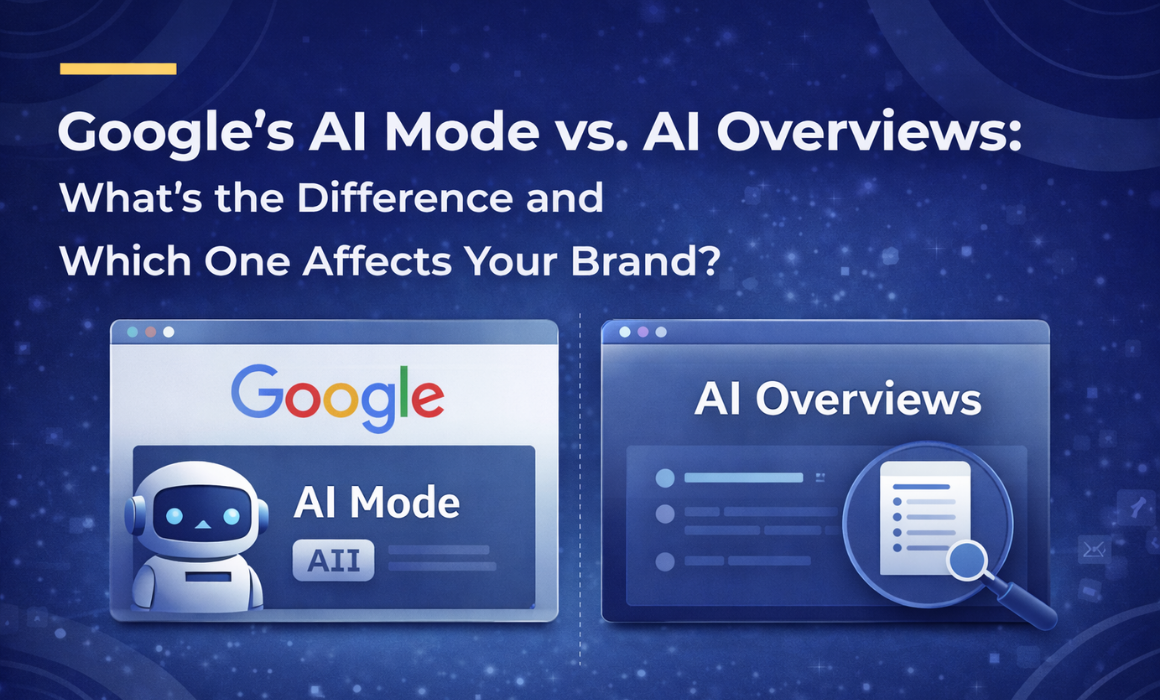
Google’s AI Mode vs. AI Overviews: What’s the Difference and Which One Affects Your Brand?

If you have been watching your Google Search Console data lately and wondering why impressions are holding steady while clicks keep dropping, you are not imagining things. Something structural has changed. And the culprit is not one feature but two, both of which Google has quietly rolled out to over 180 countries and both of which are eating into organic traffic in ways that traditional SEO metrics are only just beginning to capture.

AI Overviews and AI Mode. Two products, two completely different behaviours, two different problems for your brand, and most marketing teams are treating them as the same thing. They are not.


AI Overviews: The Answer at the Top of the Page You Cannot Scroll Past

AI Overviews have been live since 2024. You have seen them, even if you did not know the name: that boxed AI-generated summary sitting above the first organic result, answering your question before you have even looked at a single link.

They were designed to handle straightforward informational queries, definitions, quick comparisons, and factual lookups. Type in something like “best time to post on Instagram” or “what does a performance marketing agency do”, and an AI Overview answers it right there, cites three or four sources with small links, and leaves the rest of the results page below the fold.

The traffic impact has been severe and well-documented. By December 2025, AI Overviews were reducing click-through rates for the top organic position by 58% compared to two years earlier. Not 5%. Not 15%. Fifty-eight percent. A page that once reliably drove 1,000 monthly visitors from a single top ranking now delivers 400. The ranking has not changed. The visibility has not changed. The clicks have collapsed.

Where AI Overviews still leave room for brands is in the citations; those small linked sources inside the Overview box are real traffic opportunities. Users who do click through from an AI Overview are already pre-informed, already interested, and far closer to a decision than someone casually browsing results. The click is harder to earn. But when it happens, it means something.


AI Mode: A Different Beast Entirely

AI Mode is not an enhancement of the search results page. It replaces it.

Launched in May 2025 in the US and expanded globally by October, AI Mode is accessed through a dedicated tab in Google Search powered by Gemini 2.5. When a user opts into AI Mode, there are no ten blue links. No organic rankings. No ads at the top. Just a fully conversational AI interface that takes a question, runs up to sixteen separate searches simultaneously behind the scenes, synthesises the results, and responds in plain language with cited sources.

This is what Google built for the complex stuff. Research. Comparisons. Planning. Decision-making. The kind of queries where someone types an actual sentence rather than a keyword fragment. “Which digital marketing agency in Mumbai has experience with D2C food brands and performance marketing”, rather than just “marketing agency Mumbai.”

The user behaviour data coming out of AI Mode is striking. Users arriving from AI Mode sessions spend more time on the websites they do visit and view more pages per session than those coming from traditional search. The catch, of course, is that they visit far fewer websites in the first place. AI Mode sessions average between 2 and 3.5 searches total, compared to 5.6 for regular Google Search. Users are going deeper, not wider. Which means if your brand is not in the AI Mode answer, there is a real chance it is not considered at all.


What Actually Matters for Your Brand

Here is the practical breakdown of how these two features differ, and why each demands a different response from your marketing strategy:


AI Overviews

Where it appears: Sits on top of the standard Google results page. You still see organic links below it, but most users never scroll that far.

Best for: Quick answers, definitions, and simple comparisons, the kind of query someone types when they want a fast answer, not a deep dive.

Opt-in required: No. It shows up automatically whenever Google decides a query warrants an AI-generated answer. You have no say in when it appears.

Traffic impact: A 58% drop in click-through rates at position one as of December 2025. You can rank first and still lose more than half your expected traffic to the AI box sitting above you.

Traffic quality when cited: High. Anyone who clicks through from an AI Overview has already read the summary and still wants more; that is a pre-warmed visitor, not a casual browser.


AI Mode

Where it appears: Replaces the results page entirely. When a user switches to the AI Mode tab, there are no organic links, no ads, no positions, just a conversational AI response.

Best for: Deep research, vendor comparisons, planning, and multi-step decisions, the kind of query someone types when they are actually trying to make a call.

Opt-in required: Yes. The user has to deliberately select the AI Mode tab, which means anyone using it has already chosen to go deeper. That intent matters.

Traffic impact: Near-zero organic visibility if your brand is not cited. There is no position two or five to fall back on; either the AI includes you, or you do not exist in that session.

Traffic quality when cited: Very high. AI Mode users spend more time on the site and view more pages per session than visitors from standard search. They arrive already informed and ready to evaluate, not just browse.


So Which One Should Your Brand Be Optimising for?

Both. But for different parts of your funnel, and with different tactics.

AI Overviews affect brand awareness and discovery. They sit at the top of queries your potential customers are typing every day, the kind of informational searches that happen before anyone is ready to buy. Being cited in AI Overviews is about getting your name into the consideration set early. To get there, your content needs to be clear, answer-first, and well-structured. Long-tail queries of four or more words trigger AI Overviews more than 60% of the time, which means the detailed explainer content your team has probably been deprioritising is now more strategically important than ever.

AI Mode, on the other hand, is where the actual decisions are being made. The user who switches to AI Mode to compare digital marketing agencies in Mumbai is not browsing. They are building a shortlist. Getting cited in AI Mode responses requires something broader: a genuine presence across trusted third-party sources, a website that loads fast and structures information logically, and content that holds up under the multi-layered scrutiny of an AI running sixteen concurrent searches to verify what it thinks it knows about you.

The mistake most brands make is treating both features as an SEO problem when they are actually a content authority problem. Climbing to position one is no longer enough. Being worth citing is what matters now.


Three Practical Things to Do Right Now

Audit your content for answer-first writing. 

Open your five highest-traffic pages and count how many sentences it takes before you actually answer the question the page promises to address. If the answer is more than three, rewrite the opening. AI systems pull passage-level content, not page-level rankings.


Search your own brand in AI Mode. 

Type the questions your best customers ask when they are evaluating whether to hire you or buy from you. See what comes back. If your brand is missing, the gap you are looking at is not an SEO problem. It is an authority gap, and it tells you exactly where to focus.


Stop measuring success only by rankings. 

In Google Search Console, data from AI Mode now feeds into the Performance report. Track AI citation appearances separately from organic position data. A page that drops from position one to position three but starts appearing in AI Overviews may actually be generating more qualified traffic than before, just less of it. The metrics need to catch up with the new reality.

The brands navigating this well are not doing more SEO. They are doing smarter SEO.

At Spectadors, we help brands build the kind of content and authority that earns citations in both AI Overviews and AI Mode, not as a one-off project but as an ongoing part of how we approach visibility. If you want an honest audit of where your brand currently stands in Google’s AI search features, and a clear plan for closing the gap, we would be glad to walk you through it.


Talk to Spectadors  →  info@spectadors.com  |  +91 9619012041

Categories
Blog

Why Brands Are Moving Away from Celebrity Influencers to Micro-Creators (And Why It’s Working) 

Picture two competing skincare brands. Same budget: four crore rupees. Brand A puts it all into a single Instagram post from a celebrity with ten million followers. The reach numbers look fantastic in the campaign report. The sales numbers, not so much.

Brand B takes that same four crore and splits it across twenty micro-creators, each with fifty thousand highly engaged followers in the exact audience segment they are targeting. The reach is comparable. But the engagement, the conversations, the DMs, the website traffic, and the actual purchases are nowhere near comparable. Brand B wins, and it is not particularly close.

This is not hypothetical. We see this play out repeatedly across the campaigns we run at Spectadors. And it has fundamentally changed how we advise brands when they come to us asking how to spend their influencer marketing budgets.


The Numbers Behind the Shift

Celebrity brand endorsements in India have fallen to 22% of total influencer spend in 2025, down from being the dominant model just five years ago. That is not an accident. Brands have been running the numbers, and the numbers keep pointing in the same direction.

Micro-influencers, those with between ten thousand and a hundred thousand followers, retain 60 to 70% of their viewers on video content. Celebrity-led content retains 30 to 40%. Think about what that means in practice. A brand pays ten times more for a celebrity and gets half the actual attention. The math simply does not hold up for most categories, especially for D2C brands, food and beverage, beauty, and lifestyle, where purchase decisions are driven by trust and relatability rather than aspiration.

At the conversion end, the gap widens further. A brand investing two lakh rupees in a single macro-influencer reel with 8.5 lakh followers once ended up with eighteen confirmed purchases from that campaign. Eighteen. That is not a strategy. That is a very expensive awareness exercise dressed up as performance marketing.


What We Have Learned Running These Campaigns

At Spectadors, influencer marketing is one of the services we have worked on longest and most extensively. Across categories including hospitality, personal care, food, fashion, and lifestyle, we have managed campaigns spanning both ends of the creator spectrum. Here is what that experience has consistently shown us.

The brief quality gap is real but fixable. One of the most common reasons micro-creator campaigns underperform is not the creators themselves. It is the brief. Celebrity campaigns are handled by large management teams with seasoned negotiators. Micro-creator campaigns often get a generic product description and a list of do-nots. The brands that brief micro-creators as genuine collaborators, sharing the brand’s actual story and giving creators room to tell it in their own voice, consistently outperform those that treat them as distribution channels.

Volume with the right filters beats one big name every time. The sweet spot we have found for most mid-market Indian brands is somewhere between fifteen and thirty micro-creators per campaign, selected based on audience-brand fit rather than follower count alone. Engagement rate, audience location, category relevance, and content quality all matter more than the headline number. A creator with forty thousand followers in Mumbai who posts authentically about clean beauty is worth more to a personal care brand than a creator with four hundred thousand followers whose audience spans multiple unrelated interest categories.

One campaign, one sustainable fashion brand. CPA dropped 40% after we moved the budget from a single celebrity to thirty micro-creators. The celebrity generated awareness. The micro-creators generated conversions. That distinction, awareness versus conversion, is the most important question a brand should be asking before it decides where to spend.


Why Audiences Trust Micro-Creators More

There is a psychological reason this works, and it is not complicated. When a Bollywood actress holds up a face wash, the audience is aware they are watching an advertisement. The transaction is visible. When a creator with forty thousand followers who has been posting about skincare for three years recommends the same face wash, it feels like advice. That gap in perceived intent is everything in a market where consumers have become increasingly sophisticated about what they trust.

India’s internet is also no longer a single, homogeneous market. Regional creators speaking in Tamil, Marathi, Kannada, or Bhojpuri reach audiences that a national celebrity simply cannot speak to with the same cultural fluency. For brands pushing into Tier 2 and Tier 3 cities, and there are a lot of them right now, this is not a nice-to-have. It is the only strategy that actually works.


When Celebrity Influencers Still Make Sense

Being honest here matters. Celebrity influencers are not extinct, and they are not irrelevant. For a new brand entering a highly competitive mass-market category and needing nationwide awareness fast, a well-chosen celebrity partnership still creates a kind of credibility signal that a micro-creator network takes months to build. For luxury positioning, premium smartphone launches, or major brand restages, the halo effect of a celebrity is genuinely difficult to replicate.

The most effective model we have seen, and the one we increasingly recommend for brands with meaningful budgets, is a hybrid approach. One or two celebrity or macro-creator placements to establish narrative and generate awareness at scale. Fifteen to thirty micro-creators running simultaneously to convert that awareness into actual intent and purchase. The celebrity builds curiosity. The micro-creator network closes it.


Where This Is All Going in 2026 and Beyond

India’s influencer marketing industry is projected to hit INR 3,375 crore in 2026, growing at 25% year on year. The share of that going to micro and nano creators is accelerating. Performance-based deals, where creators earn on results rather than flat fees, are becoming standard. Long-term creator partnerships are replacing one-off posts. Brands are beginning to treat their best micro-creators the way they once treated brand ambassadors, with ongoing relationships built over quarters rather than campaigns measured over weeks.

The brands that win in this landscape are the ones that stop asking how many followers a creator has and start asking whether their audience is the right one. That is a harder question to answer quickly, which is exactly why getting the strategy right from the start matters.

Influencer marketing is one of the things we do with the most depth at Spectadors.

Whether you are looking to build a micro-creator network from scratch, rethink a celebrity-heavy budget, or design a hybrid strategy that uses both effectively, we have run enough of these campaigns across enough categories to give you a point of view grounded in what actually works in the Indian market. If that is a conversation worth having, we are here.

Talk to Spectadors  →  info@spectadors.com  |  +91 9619012041

Categories
Blog

What Is GEO (Generative Engine Optimisation) and Why Should Indian Brands Care?

A D2C skincare brand in Bangalore recently ran a small experiment. Their marketing head typed a question into ChatGPT that their ideal customer would ask: Which Indian skincare brands actually use clean ingredients? The AI gave a confident, detailed answer. Named four brands. Their brand was not one of them.

The brand had a decent website. Good Google rankings. An active Instagram. A solid product. None of it mattered in that moment because the AI had never been given a reason to trust them. It simply reached for the brands it already knew well, the ones that had left enough of a footprint across the web for it to feel confident recommending them.

That is the GEO problem. And most Indian brands have no idea they have it.


GEO Is Not a Rebrand of SEO. It Is a Different Game Entirely.

Generative Engine Optimisation is the practice of making your brand citable inside AI-generated answers, not just discoverable on a results page. The distinction sounds small. It is not.

When Google ranks your page, a human still has to click, read, and decide. When ChatGPT or Perplexity generates an answer, the decision is already half-made before any human gets involved. The AI has already shortlisted, already evaluated, and already formed an opinion. You either made the cut or you did not. And LLMs on average cite only two to seven domains per response. Compare that to Google, which shows ten links per page. The competition for visibility in AI answers is actually fiercer than traditional search, not easier.

What AI systems look for is fundamentally different from what Google rewards. Google values backlinks and keyword relevance. AI systems value something closer to credibility. They look for brands that are talked about consistently across independent sources, that answer questions clearly and without burying the point, and that have earned mentions from people and publications who have no financial reason to recommend them.

Research backs this up. Pages optimised for entity clarity, structure and logical flow are cited up to 58% more often in AI-generated summaries than unoptimised pages. That gap is not marginal.


Where Indian Brands Are Getting Left Behind Right Now

Here is an uncomfortable truth about the Indian digital marketing landscape. Most brands have spent years optimising for Google. Clean site structure, keyword-rich blogs, a few backlinks, maybe some local SEO. That foundation is not wasted, but it was not built with AI citation in mind. And the gaps are showing.

The typical Indian brand website has promotional content that talks about itself rather than answering questions customers actually have. There is minimal presence on Reddit, Quora, or LinkedIn in a form that AI systems trust. There are a few earned mentions in independent publications. Author bios are thin or nonexistent. Schema markup is either missing or generic.

Meanwhile, across categories from fintech to FMCG to fashion, the buyer journey is quietly shifting. B2B decision-makers use ChatGPT to research vendors before they ever visit a website. Young consumers ask Gemini or Perplexity for product comparisons. Founders type questions into AI tools that their grandparents would have asked a consultant. At every one of those touchpoints, visibility now depends not on where you rank, but on whether you have given AI systems enough to go on.

Traffic from AI referrals converts at rates 25 times higher than traditional search traffic, according to data from GEO agency research in 2025. The people arriving from an AI recommendation are not browsing. They are already sold in the category. They just need to pick a brand. If that brand is not yours, you lost a customer who was already halfway to buying.


The Three Things That Actually Move the Needle on GEO

Plenty of content online will tell you to add schema markup and post on Reddit and call it GEO. That is the surface-level version. The brands genuinely winning in AI search are doing three things that are harder to copy:

Building citation gaps before competitors notice them. The smartest GEO move right now is to identify which high-authority pages AI systems are already citing in your category, and make sure your brand is mentioned on those pages. A single placement in a TechRadar-style roundup or a well-ranked industry article can generate AI mentions across dozens of different search queries simultaneously. One placement, multiplied across every variation of the question.

Writing content that reads like an expert explaining something, not a brand selling something. AI systems have a remarkably good instinct for promotional copy versus genuine expertise. Content that leads with the answer, uses specific data, and reads naturally outperforms optimised-but-hollow content every time. Ironically, the content AI trusts most is the kind humans also find most useful.

Earning third-party validation consistently, not just occasionally. Customer reviews on Google and Trustpilot, product mentions in independent articles, community discussions where real users recommend your service, these signals tell AI systems that your brand is trusted by people with no reason to lie. You cannot fake this. You have to earn it over time. Which is exactly why starting now matters.


One More Thing Worth Saying Out Loud

GEO is not a quick fix. Any agency telling you otherwise is selling something you should not buy. It took months or years for the brands AI currently cites to build the kind of digital footprint that earns that trust. The good news is that in most Indian categories, the race has barely started. The competitor who should have started this six months ago probably has not yet.

The brands that own AI search in their categories three years from now are not going to be the ones who stumbled into it. They are going to be the ones who made a deliberate decision in 2026 to build for it, while everyone else was still arguing about whether it was worth taking seriously.

At Spectadors, GEO strategy is part of how we build visibility for brands, not an add-on.

If you want to understand where your brand actually stands in AI search right now, and what a realistic GEO strategy would look like for your category, that is a conversation worth having sooner rather than later.


Talk to Spectadors  →  info@spectadors.com  |  +91 9619012041

Categories
Blog

ChatGPT Is Now a Search Engine. What Does That Mean for Your Business?

Let’s be honest, when was the last time you actually Googled something the way you used to? You know, typing in a few keywords, scrolling past three ads, clicking the fourth link, reading half the article, going back, trying again? That whole ritual is slowly disappearing. And the reason is sitting right in your browser tab: ChatGPT.

It processed over 2.6 billion queries every single day as of 2025. That’s not a chatbot anymore. That’s a search engine one that talks back, doesn’t make you click anywhere, and gives you an answer in plain language. For most businesses, this shift has happened quietly in the background. But make no mistake: it’s one of the biggest changes to how customers find you that we’ve seen in the last 20 years.


So What’s Actually Changing?

Here’s a scenario that’s playing out right now, every day, across India. A founder in Mumbai wants to hire a performance marketing agency. Three years ago, she would open Google, type in a few keywords, scan the results, maybe visit four or five websites, and eventually fill a contact form.

Today, she opens ChatGPT and simply asks what to look for in a performance marketing agency in Mumbai. ChatGPT gives her a direct, conversational answer, names, criteria, and questions to ask. She never opens a browser.

If your brand isn’t being cited or referenced in that answer, you don’t exist to her.

That’s the shift. ChatGPT doesn’t send users to your website the way Google does it collapses the entire discovery and research phase into one conversation. Users skip straight from question to decision. And Google itself is rapidly following the same playbook with AI Overviews.


But Google Isn’t Dead, It’s Just Different Now

Before you throw your entire SEO strategy out the window, don’t. Google still handles 13.7 billion searches a day. It’s not going anywhere. But the way the results surface has fundamentally changed. AI Overviews now sit at the top of results pages, synthesising answers before a user ever scrolls to your organic link.

The result? Traditional click-through rates are falling. You can rank #1 on Google and still get less traffic than you did two years ago because the answer was given before anyone clicked. What this means practically is that brands now need to play two games simultaneously: rank well on Google AND get cited by AI systems like ChatGPT, Perplexity, and Google’s own AI layer.


What Does It Take to Show Up in AI Search?

This is where it gets interesting and where most brands are currently getting it wrong. AI systems don’t rank websites the way Google does. They look for something different: trustworthiness, clarity, and authority. Here’s what that actually means in practice:

Your content needs to answer questions clearly and directly. AI models pull short, citable passages. If your website buries the answer in paragraph five after 300 words of introduction, the AI moves on. Lead with the answer. Support it after.

Your brand needs to exist across the web, not just your website. ChatGPT gravitates heavily toward Wikipedia and structured knowledge bases. Perplexity leans on Reddit. Google AI Overviews cite news articles and authority sites. Being mentioned in the right places, industry publications, review platforms, and Q&A forums matters enormously.

Structured data and technical SEO still count. Schema markup helps AI systems understand what your page is actually about: your services, your location, your expertise. This isn’t optional anymore.


The Bigger Picture for Indian Brands

India’s digital adoption has always moved fast. We went from cash to UPI almost overnight, and from cable TV to OTT in the span of a few years. AI search is following the same curve. ChatGPT usage in India grew 160% in 2025. Young consumers, startup founders, and purchase decision-makers are already defaulting to AI tools for research, comparisons, and recommendations. Which means the window to get ahead of this shift before your competitors do is right now, not six months from now.

The brands that win in AI search won’t be the ones who spend the most on ads. They’ll be the ones with the clearest, most credible, most well-structured digital presence, the ones that AI systems instinctively trust and quote.

Navigating this shift is exactly what we help brands with at Spectadors. Whether your goal is to rank on Google, get cited in ChatGPT answers, or simply stop losing traffic you don’t know you’re losing, it starts with a content and SEO strategy built for the world as it is in 2026, not 2020. If you’re a brand in Mumbai or anywhere in India, wondering where to start, we’re happy to have that conversation.

Talk to Spectadors  →  info@spectadors.com  |  +91 9619012041

Categories
Blog

Effective Content Marketing Strategies for 2025 & 2026

The content marketing landscape is evolving rapidly, and businesses must adapt to stay competitive. At Spectadors Digital Agency, we’ve identified the most effective content marketing strategies that will dominate content marketing trends 2025 and beyond. Here’s your comprehensive guide to mastering digital content marketing 2025.


AI-Powered Content Revolution

AI content marketing strategies are reshaping how brands create and distribute content. Generative AI content marketing enables businesses to produce personalised content at scale, while machine learning content optimisation ensures maximum engagement. Spectadors Digital Agency leverages AI-driven content creation tools to deliver data-driven content marketing strategies that achieve measurable results.


User Generated Content (UGC)

User-generated content (UGC) strategies are transforming the way brands build authenticity and trust. By harnessing the voices of real customers, UGC not only fosters genuine brand advocacy but also strengthens community engagement. Influencers play a pivotal role in this ecosystem, amplifying UGC with their trusted voices and reaching highly engaged audiences. At Spectadors Digital Agency, we help brands seamlessly integrate influencers into their UGC campaigns, identifying the right creators, co-creating content that aligns with brand values, and optimising campaigns for maximum engagement. This approach ensures authentic customer experiences are amplified, driving higher trust, loyalty, and conversions.


Interactive and Immersive Experiences

Interactive content marketing is becoming essential for audience engagement. Video marketing strategies 2025 now include AR, VR content marketing and live streaming content marketing to create memorable brand experiences. Spectadors Digital Agency specialises in developing interactive content experiences that convert browsers into loyal customers.


Platform-Specific Excellence

Success requires mastering social media content strategies across multiple channels. Instagram content marketing 2025, LinkedIn content marketing strategies, and YouTube content optimization demand unique approaches. Our team at Spectadors Digital Agency creates tailored B2B content marketing strategies and ecommerce content marketing 2025 campaigns that resonate with specific audiences.


Performance-Driven Approach

Content marketing ROI 2025 depends on strategic measurement and optimisation. Content performance tracking through content marketing analytics tools provides insights into content engagement strategies. Spectadors Digital Agency focuses on content conversion optimisation using content marketing KPIs 2025 to ensure every piece delivers value.


Emerging Trends to Watch

Voice search content optimization and conversational AI content are gaining momentum as content marketing predictions for 2026 suggest increased adoption of voice-activated devices. Community-driven content and user-generated content strategies build authentic brand connections.


Conclusion

The future of content marketing 2025 2026 lies in combining AI content personalisation with authentic storytelling. Spectadors Digital Agency stays ahead of emerging content marketing trends to deliver advanced content marketing tactics in 2025 that drive growth. Our content marketing automation tools and expertise in predictive content marketing ensure your brand thrives in the evolving digital landscape.


Ready to revolutionise your content strategy? Contact Spectadors Digital Agency today for cutting-edge content marketing strategies that work in 2025 and beyond.

Categories
Blog

What to Look for in a Website Design Agency

Choosing the right website design agency can make or break your online presence. With countless web design companies competing for your attention, it’s crucial to know what separates exceptional agencies from mediocre ones. At Spectadors Digital Agency, we’ve helped numerous businesses navigate this decision, and here’s your comprehensive guide to selecting the right web design agency for your business.


Portfolio Quality and Relevance

The first thing to examine when choosing web design agency partners is their portfolio. Look beyond aesthetics and focus on functionality, user experience, and industry relevance. A reputable digital design agency should showcase diverse projects that demonstrate their ability to create responsive web design and mobile-friendly web design solutions across different sectors. Spectadors Digital Agency ensures every custom web design agency project in our portfolio reflects real-world performance, not just visual appeal.


Technical Expertise and Services

What makes a good web design agency is its comprehensive skill set. The best web design agency should offer professional web design services, including e-commerce web design, WordPress web design, UX/UI design agency services, and SEO integration. At Spectadors Digital Agency, we provide full-service web design agency solutions, from initial web design consultation through website maintenance services and ongoing support.


Communication and Project Management

Transparent communication separates experienced web design agency providers from amateurs. Questions to ask web design agency representatives should include their web design project timeline, revision policies, and website design process. Watch for web design agency red flags like poor communication or unrealistic promises. Spectadors Digital Agency maintains clear communication protocols throughout every project phase.


 Pricing and Value Proposition

When searching for an affordable web design agency, remember that web design agency pricing varies significantly based on scope and quality. Compare web design agency vs freelancer options carefully. Local web design agency providers like Spectadors Digital Agency often offer better value through personalized service and ongoing relationships.


Client Testimonials and Reviews

Web design agency testimonials and web design agency portfolio reviews provide crucial insights into client satisfaction. Look for detailed case studies showing measurable results, including website redesign services outcomes and conversion improvements.


Conclusion

How to choose web design agency partners requires evaluating multiple factors to consider when choosing web design agency providers. The right web design company selection impacts your business growth significantly. Spectadors Digital Agency combines technical expertise, transparent communication, and proven results to deliver exceptional website development agency services.


Ready to transform your online presence? Contact Spectadors Digital Agency today for a comprehensive web design consultation and discover how we can elevate your digital success.