

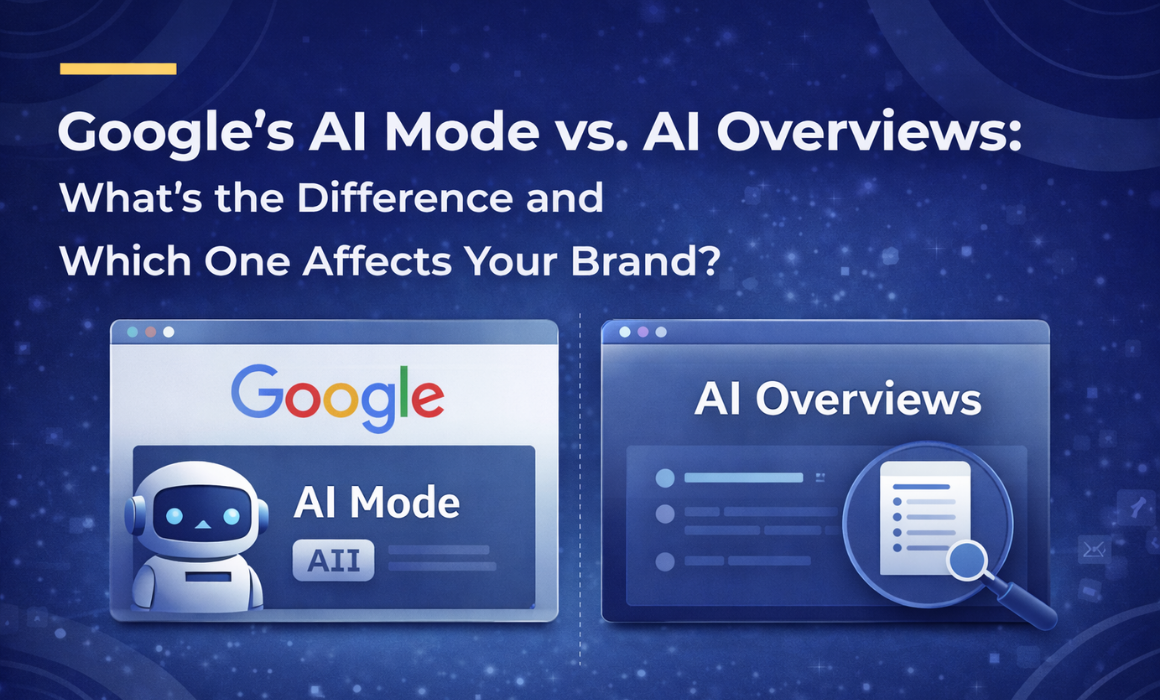
If you have been watching your Google Search Console data lately and wondering why impressions are holding steady while clicks keep dropping, you are not imagining things. Something structural has changed. And the culprit is not one feature but two, both of which Google has quietly rolled out to over 180 countries and both of which are eating into organic traffic in ways that traditional SEO metrics are only just beginning to capture.
AI Overviews and AI Mode. Two products, two completely different behaviours, two different problems for your brand, and most marketing teams are treating them as the same thing. They are not.
AI Overviews: The Answer at the Top of the Page You Cannot Scroll Past
AI Overviews have been live since 2024. You have seen them, even if you did not know the name: that boxed AI-generated summary sitting above the first organic result, answering your question before you have even looked at a single link.
They were designed to handle straightforward informational queries, definitions, quick comparisons, and factual lookups. Type in something like “best time to post on Instagram” or “what does a performance marketing agency do”, and an AI Overview answers it right there, cites three or four sources with small links, and leaves the rest of the results page below the fold.
The traffic impact has been severe and well-documented. By December 2025, AI Overviews were reducing click-through rates for the top organic position by 58% compared to two years earlier. Not 5%. Not 15%. Fifty-eight percent. A page that once reliably drove 1,000 monthly visitors from a single top ranking now delivers 400. The ranking has not changed. The visibility has not changed. The clicks have collapsed.
Where AI Overviews still leave room for brands is in the citations; those small linked sources inside the Overview box are real traffic opportunities. Users who do click through from an AI Overview are already pre-informed, already interested, and far closer to a decision than someone casually browsing results. The click is harder to earn. But when it happens, it means something.
AI Mode: A Different Beast Entirely
AI Mode is not an enhancement of the search results page. It replaces it.
Launched in May 2025 in the US and expanded globally by October, AI Mode is accessed through a dedicated tab in Google Search powered by Gemini 2.5. When a user opts into AI Mode, there are no ten blue links. No organic rankings. No ads at the top. Just a fully conversational AI interface that takes a question, runs up to sixteen separate searches simultaneously behind the scenes, synthesises the results, and responds in plain language with cited sources.
This is what Google built for the complex stuff. Research. Comparisons. Planning. Decision-making. The kind of queries where someone types an actual sentence rather than a keyword fragment. “Which digital marketing agency in Mumbai has experience with D2C food brands and performance marketing”, rather than just “marketing agency Mumbai.”
The user behaviour data coming out of AI Mode is striking. Users arriving from AI Mode sessions spend more time on the websites they do visit and view more pages per session than those coming from traditional search. The catch, of course, is that they visit far fewer websites in the first place. AI Mode sessions average between 2 and 3.5 searches total, compared to 5.6 for regular Google Search. Users are going deeper, not wider. Which means if your brand is not in the AI Mode answer, there is a real chance it is not considered at all.
What Actually Matters for Your Brand
Here is the practical breakdown of how these two features differ, and why each demands a different response from your marketing strategy:
AI Overviews
Where it appears: Sits on top of the standard Google results page. You still see organic links below it, but most users never scroll that far.
Best for: Quick answers, definitions, and simple comparisons, the kind of query someone types when they want a fast answer, not a deep dive.
Opt-in required: No. It shows up automatically whenever Google decides a query warrants an AI-generated answer. You have no say in when it appears.
Traffic impact: A 58% drop in click-through rates at position one as of December 2025. You can rank first and still lose more than half your expected traffic to the AI box sitting above you.
Traffic quality when cited: High. Anyone who clicks through from an AI Overview has already read the summary and still wants more; that is a pre-warmed visitor, not a casual browser.
AI Mode
Where it appears: Replaces the results page entirely. When a user switches to the AI Mode tab, there are no organic links, no ads, no positions, just a conversational AI response.
Best for: Deep research, vendor comparisons, planning, and multi-step decisions, the kind of query someone types when they are actually trying to make a call.
Opt-in required: Yes. The user has to deliberately select the AI Mode tab, which means anyone using it has already chosen to go deeper. That intent matters.
Traffic impact: Near-zero organic visibility if your brand is not cited. There is no position two or five to fall back on; either the AI includes you, or you do not exist in that session.
Traffic quality when cited: Very high. AI Mode users spend more time on the site and view more pages per session than visitors from standard search. They arrive already informed and ready to evaluate, not just browse.
So Which One Should Your Brand Be Optimising for?
Both. But for different parts of your funnel, and with different tactics.
AI Overviews affect brand awareness and discovery. They sit at the top of queries your potential customers are typing every day, the kind of informational searches that happen before anyone is ready to buy. Being cited in AI Overviews is about getting your name into the consideration set early. To get there, your content needs to be clear, answer-first, and well-structured. Long-tail queries of four or more words trigger AI Overviews more than 60% of the time, which means the detailed explainer content your team has probably been deprioritising is now more strategically important than ever.
AI Mode, on the other hand, is where the actual decisions are being made. The user who switches to AI Mode to compare digital marketing agencies in Mumbai is not browsing. They are building a shortlist. Getting cited in AI Mode responses requires something broader: a genuine presence across trusted third-party sources, a website that loads fast and structures information logically, and content that holds up under the multi-layered scrutiny of an AI running sixteen concurrent searches to verify what it thinks it knows about you.
The mistake most brands make is treating both features as an SEO problem when they are actually a content authority problem. Climbing to position one is no longer enough. Being worth citing is what matters now.
Three Practical Things to Do Right Now
Audit your content for answer-first writing.
Open your five highest-traffic pages and count how many sentences it takes before you actually answer the question the page promises to address. If the answer is more than three, rewrite the opening. AI systems pull passage-level content, not page-level rankings.
Search your own brand in AI Mode.
Type the questions your best customers ask when they are evaluating whether to hire you or buy from you. See what comes back. If your brand is missing, the gap you are looking at is not an SEO problem. It is an authority gap, and it tells you exactly where to focus.
Stop measuring success only by rankings.
In Google Search Console, data from AI Mode now feeds into the Performance report. Track AI citation appearances separately from organic position data. A page that drops from position one to position three but starts appearing in AI Overviews may actually be generating more qualified traffic than before, just less of it. The metrics need to catch up with the new reality.
The brands navigating this well are not doing more SEO. They are doing smarter SEO.
At Spectadors, we help brands build the kind of content and authority that earns citations in both AI Overviews and AI Mode, not as a one-off project but as an ongoing part of how we approach visibility. If you want an honest audit of where your brand currently stands in Google’s AI search features, and a clear plan for closing the gap, we would be glad to walk you through it.
Talk to Spectadors → info@spectadors.com | +91 9619012041