Spectadors

Categories
Blog

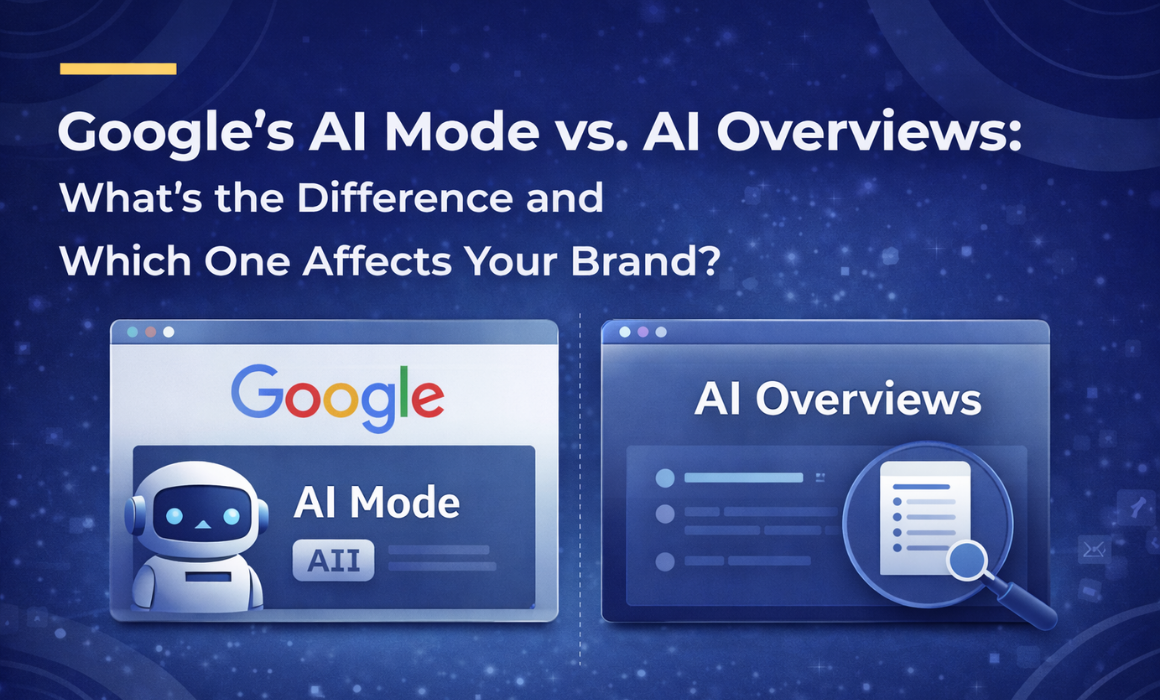
Google’s AI Mode vs. AI Overviews: What’s the Difference and Which One Affects Your Brand?

If you have been watching your Google Search Console data lately and wondering why impressions are holding steady while clicks keep dropping, you are not imagining things. Something structural has changed. And the culprit is not one feature but two, both of which Google has quietly rolled out to over 180 countries and both of which are eating into organic traffic in ways that traditional SEO metrics are only just beginning to capture.

AI Overviews and AI Mode. Two products, two completely different behaviours, two different problems for your brand, and most marketing teams are treating them as the same thing. They are not.


AI Overviews: The Answer at the Top of the Page You Cannot Scroll Past

AI Overviews have been live since 2024. You have seen them, even if you did not know the name: that boxed AI-generated summary sitting above the first organic result, answering your question before you have even looked at a single link.

They were designed to handle straightforward informational queries, definitions, quick comparisons, and factual lookups. Type in something like “best time to post on Instagram” or “what does a performance marketing agency do”, and an AI Overview answers it right there, cites three or four sources with small links, and leaves the rest of the results page below the fold.

The traffic impact has been severe and well-documented. By December 2025, AI Overviews were reducing click-through rates for the top organic position by 58% compared to two years earlier. Not 5%. Not 15%. Fifty-eight percent. A page that once reliably drove 1,000 monthly visitors from a single top ranking now delivers 400. The ranking has not changed. The visibility has not changed. The clicks have collapsed.

Where AI Overviews still leave room for brands is in the citations; those small linked sources inside the Overview box are real traffic opportunities. Users who do click through from an AI Overview are already pre-informed, already interested, and far closer to a decision than someone casually browsing results. The click is harder to earn. But when it happens, it means something.


AI Mode: A Different Beast Entirely

AI Mode is not an enhancement of the search results page. It replaces it.

Launched in May 2025 in the US and expanded globally by October, AI Mode is accessed through a dedicated tab in Google Search powered by Gemini 2.5. When a user opts into AI Mode, there are no ten blue links. No organic rankings. No ads at the top. Just a fully conversational AI interface that takes a question, runs up to sixteen separate searches simultaneously behind the scenes, synthesises the results, and responds in plain language with cited sources.

This is what Google built for the complex stuff. Research. Comparisons. Planning. Decision-making. The kind of queries where someone types an actual sentence rather than a keyword fragment. “Which digital marketing agency in Mumbai has experience with D2C food brands and performance marketing”, rather than just “marketing agency Mumbai.”

The user behaviour data coming out of AI Mode is striking. Users arriving from AI Mode sessions spend more time on the websites they do visit and view more pages per session than those coming from traditional search. The catch, of course, is that they visit far fewer websites in the first place. AI Mode sessions average between 2 and 3.5 searches total, compared to 5.6 for regular Google Search. Users are going deeper, not wider. Which means if your brand is not in the AI Mode answer, there is a real chance it is not considered at all.


What Actually Matters for Your Brand

Here is the practical breakdown of how these two features differ, and why each demands a different response from your marketing strategy:


AI Overviews

Where it appears: Sits on top of the standard Google results page. You still see organic links below it, but most users never scroll that far.

Best for: Quick answers, definitions, and simple comparisons, the kind of query someone types when they want a fast answer, not a deep dive.

Opt-in required: No. It shows up automatically whenever Google decides a query warrants an AI-generated answer. You have no say in when it appears.

Traffic impact: A 58% drop in click-through rates at position one as of December 2025. You can rank first and still lose more than half your expected traffic to the AI box sitting above you.

Traffic quality when cited: High. Anyone who clicks through from an AI Overview has already read the summary and still wants more; that is a pre-warmed visitor, not a casual browser.


AI Mode

Where it appears: Replaces the results page entirely. When a user switches to the AI Mode tab, there are no organic links, no ads, no positions, just a conversational AI response.

Best for: Deep research, vendor comparisons, planning, and multi-step decisions, the kind of query someone types when they are actually trying to make a call.

Opt-in required: Yes. The user has to deliberately select the AI Mode tab, which means anyone using it has already chosen to go deeper. That intent matters.

Traffic impact: Near-zero organic visibility if your brand is not cited. There is no position two or five to fall back on; either the AI includes you, or you do not exist in that session.

Traffic quality when cited: Very high. AI Mode users spend more time on the site and view more pages per session than visitors from standard search. They arrive already informed and ready to evaluate, not just browse.


So Which One Should Your Brand Be Optimising for?

Both. But for different parts of your funnel, and with different tactics.

AI Overviews affect brand awareness and discovery. They sit at the top of queries your potential customers are typing every day, the kind of informational searches that happen before anyone is ready to buy. Being cited in AI Overviews is about getting your name into the consideration set early. To get there, your content needs to be clear, answer-first, and well-structured. Long-tail queries of four or more words trigger AI Overviews more than 60% of the time, which means the detailed explainer content your team has probably been deprioritising is now more strategically important than ever.

AI Mode, on the other hand, is where the actual decisions are being made. The user who switches to AI Mode to compare digital marketing agencies in Mumbai is not browsing. They are building a shortlist. Getting cited in AI Mode responses requires something broader: a genuine presence across trusted third-party sources, a website that loads fast and structures information logically, and content that holds up under the multi-layered scrutiny of an AI running sixteen concurrent searches to verify what it thinks it knows about you.

The mistake most brands make is treating both features as an SEO problem when they are actually a content authority problem. Climbing to position one is no longer enough. Being worth citing is what matters now.


Three Practical Things to Do Right Now

Audit your content for answer-first writing. 

Open your five highest-traffic pages and count how many sentences it takes before you actually answer the question the page promises to address. If the answer is more than three, rewrite the opening. AI systems pull passage-level content, not page-level rankings.


Search your own brand in AI Mode. 

Type the questions your best customers ask when they are evaluating whether to hire you or buy from you. See what comes back. If your brand is missing, the gap you are looking at is not an SEO problem. It is an authority gap, and it tells you exactly where to focus.


Stop measuring success only by rankings. 

In Google Search Console, data from AI Mode now feeds into the Performance report. Track AI citation appearances separately from organic position data. A page that drops from position one to position three but starts appearing in AI Overviews may actually be generating more qualified traffic than before, just less of it. The metrics need to catch up with the new reality.

The brands navigating this well are not doing more SEO. They are doing smarter SEO.

At Spectadors, we help brands build the kind of content and authority that earns citations in both AI Overviews and AI Mode, not as a one-off project but as an ongoing part of how we approach visibility. If you want an honest audit of where your brand currently stands in Google’s AI search features, and a clear plan for closing the gap, we would be glad to walk you through it.


Talk to Spectadors  →  info@spectadors.com  |  +91 9619012041

Categories
Blog

Why Brands Are Moving Away from Celebrity Influencers to Micro-Creators (And Why It’s Working) 

Picture two competing skincare brands. Same budget: four crore rupees. Brand A puts it all into a single Instagram post from a celebrity with ten million followers. The reach numbers look fantastic in the campaign report. The sales numbers, not so much.

Brand B takes that same four crore and splits it across twenty micro-creators, each with fifty thousand highly engaged followers in the exact audience segment they are targeting. The reach is comparable. But the engagement, the conversations, the DMs, the website traffic, and the actual purchases are nowhere near comparable. Brand B wins, and it is not particularly close.

This is not hypothetical. We see this play out repeatedly across the campaigns we run at Spectadors. And it has fundamentally changed how we advise brands when they come to us asking how to spend their influencer marketing budgets.


The Numbers Behind the Shift

Celebrity brand endorsements in India have fallen to 22% of total influencer spend in 2025, down from being the dominant model just five years ago. That is not an accident. Brands have been running the numbers, and the numbers keep pointing in the same direction.

Micro-influencers, those with between ten thousand and a hundred thousand followers, retain 60 to 70% of their viewers on video content. Celebrity-led content retains 30 to 40%. Think about what that means in practice. A brand pays ten times more for a celebrity and gets half the actual attention. The math simply does not hold up for most categories, especially for D2C brands, food and beverage, beauty, and lifestyle, where purchase decisions are driven by trust and relatability rather than aspiration.

At the conversion end, the gap widens further. A brand investing two lakh rupees in a single macro-influencer reel with 8.5 lakh followers once ended up with eighteen confirmed purchases from that campaign. Eighteen. That is not a strategy. That is a very expensive awareness exercise dressed up as performance marketing.


What We Have Learned Running These Campaigns

At Spectadors, influencer marketing is one of the services we have worked on longest and most extensively. Across categories including hospitality, personal care, food, fashion, and lifestyle, we have managed campaigns spanning both ends of the creator spectrum. Here is what that experience has consistently shown us.

The brief quality gap is real but fixable. One of the most common reasons micro-creator campaigns underperform is not the creators themselves. It is the brief. Celebrity campaigns are handled by large management teams with seasoned negotiators. Micro-creator campaigns often get a generic product description and a list of do-nots. The brands that brief micro-creators as genuine collaborators, sharing the brand’s actual story and giving creators room to tell it in their own voice, consistently outperform those that treat them as distribution channels.

Volume with the right filters beats one big name every time. The sweet spot we have found for most mid-market Indian brands is somewhere between fifteen and thirty micro-creators per campaign, selected based on audience-brand fit rather than follower count alone. Engagement rate, audience location, category relevance, and content quality all matter more than the headline number. A creator with forty thousand followers in Mumbai who posts authentically about clean beauty is worth more to a personal care brand than a creator with four hundred thousand followers whose audience spans multiple unrelated interest categories.

One campaign, one sustainable fashion brand. CPA dropped 40% after we moved the budget from a single celebrity to thirty micro-creators. The celebrity generated awareness. The micro-creators generated conversions. That distinction, awareness versus conversion, is the most important question a brand should be asking before it decides where to spend.


Why Audiences Trust Micro-Creators More

There is a psychological reason this works, and it is not complicated. When a Bollywood actress holds up a face wash, the audience is aware they are watching an advertisement. The transaction is visible. When a creator with forty thousand followers who has been posting about skincare for three years recommends the same face wash, it feels like advice. That gap in perceived intent is everything in a market where consumers have become increasingly sophisticated about what they trust.

India’s internet is also no longer a single, homogeneous market. Regional creators speaking in Tamil, Marathi, Kannada, or Bhojpuri reach audiences that a national celebrity simply cannot speak to with the same cultural fluency. For brands pushing into Tier 2 and Tier 3 cities, and there are a lot of them right now, this is not a nice-to-have. It is the only strategy that actually works.


When Celebrity Influencers Still Make Sense

Being honest here matters. Celebrity influencers are not extinct, and they are not irrelevant. For a new brand entering a highly competitive mass-market category and needing nationwide awareness fast, a well-chosen celebrity partnership still creates a kind of credibility signal that a micro-creator network takes months to build. For luxury positioning, premium smartphone launches, or major brand restages, the halo effect of a celebrity is genuinely difficult to replicate.

The most effective model we have seen, and the one we increasingly recommend for brands with meaningful budgets, is a hybrid approach. One or two celebrity or macro-creator placements to establish narrative and generate awareness at scale. Fifteen to thirty micro-creators running simultaneously to convert that awareness into actual intent and purchase. The celebrity builds curiosity. The micro-creator network closes it.


Where This Is All Going in 2026 and Beyond

India’s influencer marketing industry is projected to hit INR 3,375 crore in 2026, growing at 25% year on year. The share of that going to micro and nano creators is accelerating. Performance-based deals, where creators earn on results rather than flat fees, are becoming standard. Long-term creator partnerships are replacing one-off posts. Brands are beginning to treat their best micro-creators the way they once treated brand ambassadors, with ongoing relationships built over quarters rather than campaigns measured over weeks.

The brands that win in this landscape are the ones that stop asking how many followers a creator has and start asking whether their audience is the right one. That is a harder question to answer quickly, which is exactly why getting the strategy right from the start matters.

Influencer marketing is one of the things we do with the most depth at Spectadors.

Whether you are looking to build a micro-creator network from scratch, rethink a celebrity-heavy budget, or design a hybrid strategy that uses both effectively, we have run enough of these campaigns across enough categories to give you a point of view grounded in what actually works in the Indian market. If that is a conversation worth having, we are here.

Talk to Spectadors  →  info@spectadors.com  |  +91 9619012041
Categories
Blog

What Is GEO (Generative Engine Optimisation) and Why Should Indian Brands Care?

A D2C skincare brand in Bangalore recently ran a small experiment. Their marketing head typed a question into ChatGPT that their ideal customer would ask: Which Indian skincare brands actually use clean ingredients? The AI gave a confident, detailed answer. Named four brands. Their brand was not one of them.

The brand had a decent website. Good Google rankings. An active Instagram. A solid product. None of it mattered in that moment because the AI had never been given a reason to trust them. It simply reached for the brands it already knew well, the ones that had left enough of a footprint across the web for it to feel confident recommending them.

That is the GEO problem. And most Indian brands have no idea they have it.


GEO Is Not a Rebrand of SEO. It Is a Different Game Entirely.

Generative Engine Optimisation is the practice of making your brand citable inside AI-generated answers, not just discoverable on a results page. The distinction sounds small. It is not.

When Google ranks your page, a human still has to click, read, and decide. When ChatGPT or Perplexity generates an answer, the decision is already half-made before any human gets involved. The AI has already shortlisted, already evaluated, and already formed an opinion. You either made the cut or you did not. And LLMs on average cite only two to seven domains per response. Compare that to Google, which shows ten links per page. The competition for visibility in AI answers is actually fiercer than traditional search, not easier.

What AI systems look for is fundamentally different from what Google rewards. Google values backlinks and keyword relevance. AI systems value something closer to credibility. They look for brands that are talked about consistently across independent sources, that answer questions clearly and without burying the point, and that have earned mentions from people and publications who have no financial reason to recommend them.

Research backs this up. Pages optimised for entity clarity, structure and logical flow are cited up to 58% more often in AI-generated summaries than unoptimised pages. That gap is not marginal.


Where Indian Brands Are Getting Left Behind Right Now

Here is an uncomfortable truth about the Indian digital marketing landscape. Most brands have spent years optimising for Google. Clean site structure, keyword-rich blogs, a few backlinks, maybe some local SEO. That foundation is not wasted, but it was not built with AI citation in mind. And the gaps are showing.

The typical Indian brand website has promotional content that talks about itself rather than answering questions customers actually have. There is minimal presence on Reddit, Quora, or LinkedIn in a form that AI systems trust. There are a few earned mentions in independent publications. Author bios are thin or nonexistent. Schema markup is either missing or generic.

Meanwhile, across categories from fintech to FMCG to fashion, the buyer journey is quietly shifting. B2B decision-makers use ChatGPT to research vendors before they ever visit a website. Young consumers ask Gemini or Perplexity for product comparisons. Founders type questions into AI tools that their grandparents would have asked a consultant. At every one of those touchpoints, visibility now depends not on where you rank, but on whether you have given AI systems enough to go on.

Traffic from AI referrals converts at rates 25 times higher than traditional search traffic, according to data from GEO agency research in 2025. The people arriving from an AI recommendation are not browsing. They are already sold in the category. They just need to pick a brand. If that brand is not yours, you lost a customer who was already halfway to buying.


The Three Things That Actually Move the Needle on GEO

Plenty of content online will tell you to add schema markup and post on Reddit and call it GEO. That is the surface-level version. The brands genuinely winning in AI search are doing three things that are harder to copy:

Building citation gaps before competitors notice them. The smartest GEO move right now is to identify which high-authority pages AI systems are already citing in your category, and make sure your brand is mentioned on those pages. A single placement in a TechRadar-style roundup or a well-ranked industry article can generate AI mentions across dozens of different search queries simultaneously. One placement, multiplied across every variation of the question.

Writing content that reads like an expert explaining something, not a brand selling something. AI systems have a remarkably good instinct for promotional copy versus genuine expertise. Content that leads with the answer, uses specific data, and reads naturally outperforms optimised-but-hollow content every time. Ironically, the content AI trusts most is the kind humans also find most useful.

Earning third-party validation consistently, not just occasionally. Customer reviews on Google and Trustpilot, product mentions in independent articles, community discussions where real users recommend your service, these signals tell AI systems that your brand is trusted by people with no reason to lie. You cannot fake this. You have to earn it over time. Which is exactly why starting now matters.


One More Thing Worth Saying Out Loud

GEO is not a quick fix. Any agency telling you otherwise is selling something you should not buy. It took months or years for the brands AI currently cites to build the kind of digital footprint that earns that trust. The good news is that in most Indian categories, the race has barely started. The competitor who should have started this six months ago probably has not yet.

The brands that own AI search in their categories three years from now are not going to be the ones who stumbled into it. They are going to be the ones who made a deliberate decision in 2026 to build for it, while everyone else was still arguing about whether it was worth taking seriously.

At Spectadors, GEO strategy is part of how we build visibility for brands, not an add-on.

If you want to understand where your brand actually stands in AI search right now, and what a realistic GEO strategy would look like for your category, that is a conversation worth having sooner rather than later.


Talk to Spectadors  →  info@spectadors.com  |  +91 9619012041
Categories
Blog

ChatGPT Is Now a Search Engine. What Does That Mean for Your Business?

Let’s be honest, when was the last time you actually Googled something the way you used to? You know, typing in a few keywords, scrolling past three ads, clicking the fourth link, reading half the article, going back, trying again? That whole ritual is slowly disappearing. And the reason is sitting right in your browser tab: ChatGPT.

It processed over 2.6 billion queries every single day as of 2025. That’s not a chatbot anymore. That’s a search engine one that talks back, doesn’t make you click anywhere, and gives you an answer in plain language. For most businesses, this shift has happened quietly in the background. But make no mistake: it’s one of the biggest changes to how customers find you that we’ve seen in the last 20 years.


So What’s Actually Changing?

Here’s a scenario that’s playing out right now, every day, across India. A founder in Mumbai wants to hire a performance marketing agency. Three years ago, she would open Google, type in a few keywords, scan the results, maybe visit four or five websites, and eventually fill a contact form.

Today, she opens ChatGPT and simply asks what to look for in a performance marketing agency in Mumbai. ChatGPT gives her a direct, conversational answer, names, criteria, and questions to ask. She never opens a browser.

If your brand isn’t being cited or referenced in that answer, you don’t exist to her.

That’s the shift. ChatGPT doesn’t send users to your website the way Google does it collapses the entire discovery and research phase into one conversation. Users skip straight from question to decision. And Google itself is rapidly following the same playbook with AI Overviews.


But Google Isn’t Dead, It’s Just Different Now

Before you throw your entire SEO strategy out the window, don’t. Google still handles 13.7 billion searches a day. It’s not going anywhere. But the way the results surface has fundamentally changed. AI Overviews now sit at the top of results pages, synthesising answers before a user ever scrolls to your organic link.

The result? Traditional click-through rates are falling. You can rank #1 on Google and still get less traffic than you did two years ago because the answer was given before anyone clicked. What this means practically is that brands now need to play two games simultaneously: rank well on Google AND get cited by AI systems like ChatGPT, Perplexity, and Google’s own AI layer.


What Does It Take to Show Up in AI Search?

This is where it gets interesting and where most brands are currently getting it wrong. AI systems don’t rank websites the way Google does. They look for something different: trustworthiness, clarity, and authority. Here’s what that actually means in practice:

Your content needs to answer questions clearly and directly. AI models pull short, citable passages. If your website buries the answer in paragraph five after 300 words of introduction, the AI moves on. Lead with the answer. Support it after.

Your brand needs to exist across the web, not just your website. ChatGPT gravitates heavily toward Wikipedia and structured knowledge bases. Perplexity leans on Reddit. Google AI Overviews cite news articles and authority sites. Being mentioned in the right places, industry publications, review platforms, and Q&A forums matters enormously.

Structured data and technical SEO still count. Schema markup helps AI systems understand what your page is actually about: your services, your location, your expertise. This isn’t optional anymore.


The Bigger Picture for Indian Brands

India’s digital adoption has always moved fast. We went from cash to UPI almost overnight, and from cable TV to OTT in the span of a few years. AI search is following the same curve. ChatGPT usage in India grew 160% in 2025. Young consumers, startup founders, and purchase decision-makers are already defaulting to AI tools for research, comparisons, and recommendations. Which means the window to get ahead of this shift before your competitors do is right now, not six months from now.

The brands that win in AI search won’t be the ones who spend the most on ads. They’ll be the ones with the clearest, most credible, most well-structured digital presence, the ones that AI systems instinctively trust and quote.

Navigating this shift is exactly what we help brands with at Spectadors. Whether your goal is to rank on Google, get cited in ChatGPT answers, or simply stop losing traffic you don’t know you’re losing, it starts with a content and SEO strategy built for the world as it is in 2026, not 2020. If you’re a brand in Mumbai or anywhere in India, wondering where to start, we’re happy to have that conversation.

Talk to Spectadors  →  info@spectadors.com  |  +91 9619012041
Categories
Blog

Effective Content Marketing Strategies for 2025 & 2026

The content marketing landscape is evolving rapidly, and businesses must adapt to stay competitive. At Spectadors Digital Agency, we’ve identified the most effective content marketing strategies that will dominate content marketing trends 2025 and beyond. Here’s your comprehensive guide to mastering digital content marketing 2025.


AI-Powered Content Revolution

AI content marketing strategies are reshaping how brands create and distribute content. Generative AI content marketing enables businesses to produce personalised content at scale, while machine learning content optimisation ensures maximum engagement. Spectadors Digital Agency leverages AI-driven content creation tools to deliver data-driven content marketing strategies that achieve measurable results.


User Generated Content (UGC)

User-generated content (UGC) strategies are transforming the way brands build authenticity and trust. By harnessing the voices of real customers, UGC not only fosters genuine brand advocacy but also strengthens community engagement. Influencers play a pivotal role in this ecosystem, amplifying UGC with their trusted voices and reaching highly engaged audiences. At Spectadors Digital Agency, we help brands seamlessly integrate influencers into their UGC campaigns, identifying the right creators, co-creating content that aligns with brand values, and optimising campaigns for maximum engagement. This approach ensures authentic customer experiences are amplified, driving higher trust, loyalty, and conversions.


Interactive and Immersive Experiences

Interactive content marketing is becoming essential for audience engagement. Video marketing strategies 2025 now include AR, VR content marketing and live streaming content marketing to create memorable brand experiences. Spectadors Digital Agency specialises in developing interactive content experiences that convert browsers into loyal customers.


Platform-Specific Excellence

Success requires mastering social media content strategies across multiple channels. Instagram content marketing 2025, LinkedIn content marketing strategies, and YouTube content optimization demand unique approaches. Our team at Spectadors Digital Agency creates tailored B2B content marketing strategies and ecommerce content marketing 2025 campaigns that resonate with specific audiences.


Performance-Driven Approach

Content marketing ROI 2025 depends on strategic measurement and optimisation. Content performance tracking through content marketing analytics tools provides insights into content engagement strategies. Spectadors Digital Agency focuses on content conversion optimisation using content marketing KPIs 2025 to ensure every piece delivers value.


Emerging Trends to Watch

Voice search content optimization and conversational AI content are gaining momentum as content marketing predictions for 2026 suggest increased adoption of voice-activated devices. Community-driven content and user-generated content strategies build authentic brand connections.


Conclusion

The future of content marketing 2025 2026 lies in combining AI content personalisation with authentic storytelling. Spectadors Digital Agency stays ahead of emerging content marketing trends to deliver advanced content marketing tactics in 2025 that drive growth. Our content marketing automation tools and expertise in predictive content marketing ensure your brand thrives in the evolving digital landscape.


Ready to revolutionise your content strategy? Contact Spectadors Digital Agency today for cutting-edge content marketing strategies that work in 2025 and beyond.

Categories
Blog

What to Look for in a Website Design Agency

Choosing the right website design agency can make or break your online presence. With countless web design companies competing for your attention, it’s crucial to know what separates exceptional agencies from mediocre ones. At Spectadors Digital Agency, we’ve helped numerous businesses navigate this decision, and here’s your comprehensive guide to selecting the right web design agency for your business.


Portfolio Quality and Relevance

The first thing to examine when choosing web design agency partners is their portfolio. Look beyond aesthetics and focus on functionality, user experience, and industry relevance. A reputable digital design agency should showcase diverse projects that demonstrate their ability to create responsive web design and mobile-friendly web design solutions across different sectors. Spectadors Digital Agency ensures every custom web design agency project in our portfolio reflects real-world performance, not just visual appeal.


Technical Expertise and Services

What makes a good web design agency is its comprehensive skill set. The best web design agency should offer professional web design services, including e-commerce web design, WordPress web design, UX/UI design agency services, and SEO integration. At Spectadors Digital Agency, we provide full-service web design agency solutions, from initial web design consultation through website maintenance services and ongoing support.


Communication and Project Management

Transparent communication separates experienced web design agency providers from amateurs. Questions to ask web design agency representatives should include their web design project timeline, revision policies, and website design process. Watch for web design agency red flags like poor communication or unrealistic promises. Spectadors Digital Agency maintains clear communication protocols throughout every project phase.


 Pricing and Value Proposition

When searching for an affordable web design agency, remember that web design agency pricing varies significantly based on scope and quality. Compare web design agency vs freelancer options carefully. Local web design agency providers like Spectadors Digital Agency often offer better value through personalized service and ongoing relationships.


Client Testimonials and Reviews

Web design agency testimonials and web design agency portfolio reviews provide crucial insights into client satisfaction. Look for detailed case studies showing measurable results, including website redesign services outcomes and conversion improvements.


Conclusion

How to choose web design agency partners requires evaluating multiple factors to consider when choosing web design agency providers. The right web design company selection impacts your business growth significantly. Spectadors Digital Agency combines technical expertise, transparent communication, and proven results to deliver exceptional website development agency services.


Ready to transform your online presence? Contact Spectadors Digital Agency today for a comprehensive web design consultation and discover how we can elevate your digital success.

Categories
Blog

Top Benefits of Integrating AI in Your Marketing Strategy

Artificial Intelligence (AI) has quickly moved from being a futuristic concept to becoming an everyday business tool. For marketers, AI is not about replacing creativity; it’s about making strategies smarter, faster, and more effective.

At Spectadors Digital Agency, we’ve seen how AI helps brands cut through the noise of social media, improve customer engagement, and achieve better returns on their campaigns. Let’s break down the top benefits of integrating AI into your marketing strategy.

1. Deeper Audience Understanding

AI can analyse large amounts of customer data in seconds, something that would take teams days or weeks. It helps businesses understand:

  • What content do customers engage with most

  • When they are most active online

  • Which products or services interest them

This means you don’t waste time guessing; you build campaigns based on facts.


2. Smarter Personalisation

Customers no longer respond to generic marketing. AI allows you to personalise campaigns at scale, such as:

  • Product recommendations based on past behaviour

  • Personalised email campaigns

  • Ads tailored to specific interests

This creates a better customer experience and drives stronger engagement.


3. Efficient Content Creation and Management

AI-powered tools can help generate content ideas, suggest captions, or even create basic designs. While the creative direction still comes from humans, AI speeds up the process and keeps brands consistent across platforms.


4. Improved Campaign Performance

AI makes ad campaigns more effective by:

  • Optimizing targeting

  • Adjusting budgets in real time

  • Predicting which ads will perform better

This ensures that every rupee you spend works harder and delivers better ROI.


5. 24/7 Customer Support

AI chatbots can handle common queries, guide customers through purchases, and provide instant responses, even outside working hours. This improves customer satisfaction and reduces response time.


6. Data-Driven Decisions

With AI, marketing decisions are backed by real-time analytics, not assumptions. Predictive tools can highlight upcoming trends, helping brands act before competitors catch on.


Why This Matters for Your Brand

By combining human storytelling with AI-driven insights, businesses can create strategies that are both innovative and effective.

At Spectadors Digital Agency, we help brands integrate AI into their marketing in practical ways, from smarter content management to advanced targeting and analytics.


Final Thoughts

The benefits of AI in marketing are clear: deeper insights, smarter personalisation, stronger ROI, and better customer experiences. For brands that want to stay competitive in the digital-first world, adopting AI is no longer optional; it’s essential. If you’re ready to explore how AI can transform your marketing strategy, the Spectadors team is here to help.

Categories
Blog

What Do Social Media Marketing Services Include? A Complete Service Breakdown

Social media marketing services have become essential for businesses looking to expand their reach, engage with customers, and drive sustainable growth. But what exactly do these services include? If you’re considering partnering with a social media marketing agency, understanding the complete scope of services will help you make an informed decision.

At Spectadors Digital Agency, we’ve helped hundreds of businesses transform their social media presence into powerful revenue-generating machines. Here’s a breakdown of the complete list of what social media marketing covers.


Social Media Strategy and Planning

Every strong social media presence begins with a strategy. This includes:

-Understanding your business goals

-Identifying your target audience

-Choosing the right platforms (Instagram, Facebook, LinkedIn, YouTube, etc.)

-Setting KPIs and measurable results

Without a strategy, posting randomly on social media won’t help. A professional agency like ours ensures that every post and campaign aligns with your brand voice and long-term goals.


Content Creation and Design

Content is at the heart of social media. From eye-catching graphics to engaging videos, the right content helps your brand stand out. Services here include:

-Creative graphic design

-Reels and video editing

-Product photoshoots

-Blogs and copywriting for captions

At Spectadors, our creative team ensures that your content not only looks professional but also speaks directly to your audience.


Social Media Management

Consistency is everything. Posting once in a while will not keep your brand relevant. Social media management covers:

-Scheduling posts at the right time

-Monitoring engagement

-Maintaining a consistent brand voice

-Responding to comments and messages

This helps businesses maintain an active, approachable presence online.


Paid Advertising and Campaigns

Organic reach is important, but to grow faster, paid ads play a huge role. Social media marketing services include:

-Running targeted ad campaigns on Facebook, Instagram, and LinkedIn

-Audience targeting based on demographics, interests, and behaviours

-Budget optimisation to get maximum ROI

-Regular performance tracking and reporting

With the right strategy, ads can boost brand awareness, generate leads, and even drive sales.


Analytics and Reporting

Data tells the real story. Agencies provide detailed reports on how your social media campaigns are performing. This includes:

-Engagement rates

-Follower growth

-Reach and impressions

-Conversion tracking

By analysing these numbers, businesses can refine their strategy and achieve better results.


Influencer Marketing and Collaborations

For brands looking to connect with audiences more personally, influencer marketing is a powerful tool. Agencies help by:

-Identifying relevant influencers in your industry

-Managing collaborations and campaigns

-Tracking performance of influencer partnerships

-This builds credibility and expands your reach.


Community Building and Engagement

Beyond likes and shares, the real success of social media lies in building a loyal community. Agencies focus on:

-Creating interactive campaigns (polls, Q&As, giveaways)

-Building customer trust

-Encouraging user-generated content


When done right, your followers don’t just watch your content; they engage and become advocates for your brand.


Why Choose Spectadors Digital Agency?

At Spectadors, we don’t just manage social media, we build digital identities. With a creative team that understands design, strategy, and analytics, we offer end-to-end solutions for businesses that want to grow online. Whether you’re looking for social media marketing services in Mumbai or a complete digital marketing partner, our agency ensures your brand voice is heard loud and clear.


Final Thoughts

Social media marketing is more than just posting pictures online. It’s a mix of strategy, creativity, consistency, and analytics. From content creation to paid campaigns and influencer collaborations, every service plays a vital role in shaping how your audience perceives your brand.


If you’re ready to grow your brand with a trusted digital marketing agency in Mumbai, Spectadors is here to help.

Categories
Blog

Why You Should Be Using User-Generated Content

Let’s be real, people don’t want to be “sold to” anymore. They want something that feels genuine. Something they can trust. That’s exactly where user-generated content shines. It’s raw, relatable, and real. And in a world full of noise, it cuts through.

UGC isn’t just a marketing trend to test out when you have time. It’s something every brand should be actively leaning into. Not just for likes or shares, but to build trust, spark conversations, and grow a community that genuinely believes in what you offer.

If you’re not using it yet, now’s the time to start. And if you’re not sure where to begin or how to do it right, that’s where we come in. From planning and strategy to content curation and campaign execution, we make UGC work for your business, not just your feed.

Let’s talk about how we can make your audience your biggest asset.

What is User-Generated Content?

User-generated content refers to any content, photos, videos, reviews, testimonials, blog posts, or even social media mentions, created voluntarily by customers or users rather than the brand itself. UGC is organic, unpaid, and often more trusted by other consumers than branded content.

A few examples of UGC include:

  • A customer posting an Instagram Story wearing your product.
  • A Google or Amazon review detailing their experience
  • A YouTube video unboxing or using your service
  • A blog post mentioning your brand in a top-10 list

They are powerful brand assets that offer real, quantifiable value.

The Rise of Authenticity in the Digital Age

Modern consumers have grown sceptical of traditional advertising. According to various studies:

  • Over 90% of consumers trust UGC more than traditional advertising.
  • Brands that incorporate UGC in their marketing see a significant increase in engagement and conversions.
  • Millennials and Gen Z, in particular, rely heavily on peer reviews and influencer content before making a purchase decision.s

This shift reflects a larger trend: authenticity over perfection. Today, real people sharing real stories have more impact than curated campaigns.

Why Your Brand Needs User-Generated Content

1. Builds Trust and Credibility

Consumers trust other consumers. When they see real people using and loving your product or service, it acts as social proof. It’s the digital equivalent of word-of-mouth. Unlike paid ads, which people know are promotional, UGC feels genuine and relatable.

2. Enhances Community Engagement

UGC isn’t just about content, it’s about community. When you feature your audience’s photos, reviews, or videos, you’re not just showcasing content. You’re showing appreciation. This builds loyalty and encourages more interaction. Customers feel seen and heard, which can turn them into lifelong advocates.

3. Improves Conversion Rates

Including user-generated content on product pages or in social ads can significantly impact buying behaviour. For example, studies have shown that e-commerce sites with UGC on product pages see up to a 4.6% increase in conversion rates. It helps potential buyers visualise real use cases, validate quality, and reduce hesitation.

4. Saves Time and Resources

Creating original content consistently is resource-intensive. UGC provides a scalable and cost-effective solution. Your audience becomes your content creators, allowing your team to curate rather than create from scratch. This is especially useful for small businesses and growing brands.

5. Boosts SEO and Online Visibility

UGC in the form of reviews, social shares, and blog mentions can drive organic traffic. Google values fresh, relevant content and social proof. A constant flow of user-generated material signals to search engines that your brand is active, trusted, and relevant, helping you rank better over time.

6. Increases Social Reach and Brand Awareness

When users tag your brand in posts or use your hashtag, they’re essentially introducing you to their audience. It’s free exposure to potentially thousands of new eyes, many of whom trust the source more than any sponsored post. It’s marketing through relatability.

7. Provides Actionable Insights

Reading through customer reviews or feedback on social media can give you unfiltered insights into what people think about your product or service. This can inform product development, customer service improvements, or even future campaigns.

Where and How to Use User-Generated Content

Integrating UGC across your marketing strategy is both strategic and seamless. Here’s how to do it effectively:

1. Website and Landing Pages

Incorporate reviews, customer photos, or video testimonials on your homepage, product pages, and lead generation landing pages.

2. Social Media

Repost user stories, reshare tagged content, and build campaigns around community participation. Always ask for permission or make it easy through branded hashtags.

3. Email Marketing

Feature UGC in newsletters or drip campaigns to add trust and variation in your email content.

4. Paid Ads

Facebook and Instagram ads that include real people and authentic reviews often outperform polished studio ads.

5. In-store Displays and Packaging

Use customer quotes or images on packaging, posters, or point-of-sale displays to build a bridge between the digital and physical brand experience.

Encouraging More UGC from Your Audience

If you want more user-generated content, make it easy and rewarding for users to share. Here are a few tactics:

  • Launch hashtag campaigns
  • Offer shoutouts or reposts for tagged content.
  • Host contests or giveaways
  • Ask for reviews through email follow-up.s
  • Create shareable experiences, such as branded unboxing or aesthetic packaging.
  • Partner with micro-influencers to amplify your reach organically

Real-World Examples of Brands Winning with UGC

  • GoPro built an entire brand identity around user footage, with millions of users uploading their adventure videos.
  • Starbucks frequently launches hashtag campaigns like #RedCupContest, encouraging fans to show off their drinks in creative ways.
  • Glossier, a beauty brand, thrives on reposting makeup looks and reviews from everyday users, often turning fans into influencers.

User-generated content is not just a nice-to-have; it’s a must-have. In an era where authenticity, trust, and community drive business decisions, UGC can give your brand a strategic edge. It’s more than just content, it’s proof that people believe in your brand enough to talk about it.

By empowering your audience to participate in your story, you’re not only building marketing assets. You’re building trust, loyalty, and long-term brand equity.

How Spectadors Digital Helps Brands Leverage UGC Effectively

At Spectadors Digital, we understand that user-generated content isn’t just about reposting what your customers say; it’s about building a strategy that turns customer voices into brand power.

We help brands:

  • Identify the right platforms and communities for UGC
  • Design creative campaigns that encourage meaningful contributions.
  • Curate and moderate UGC for maximum impact
  • Integrate user content seamlessly across your website, ads, and social media
  • Measure the ROI of UGC campaigns with actionable insights
  • Get Influencers On board for content creation.

Our team blends data, creativity, and cultural relevance to ensure your brand builds authentic connections in the most human way possible.

Ready to make your customers your biggest ambassadors?

Get in touch with Spectadors Digital!

Categories
Blog

Top Reasons to Choose a Digital Marketing Agency

Have you ever felt like your in-house marketing just isn’t getting you the online visibility or sales you deserve? Maybe you’ve tried growing your social media or ranking on Google, but the results just aren’t there. It’s frustrating, right? 

The truth is, digital marketing today is more complex and fast-moving than ever. Your customers are online, searching, scrolling, and making decisions, but getting noticed in that crowded space takes more than just posting regularly or running ads.

That’s where working with a digital marketing agency makes a difference. Instead of trying to figure everything out on your own, you get experts who know the ins and outs, who stay on top of trends, and who can craft strategies that work.

In this blog, we’ll walk you through why partnering with a digital marketing agency is one of the smartest moves for your business and how an agency like Spectadors Digital can help you get the growth you’re aiming for.

Does a Digital Marketing Agency Do?

Before diving into the “why,” let’s understand the “what.”

A digital marketing agency offers end-to-end online marketing services designed to build brand awareness, drive traffic, and generate revenue. These services typically include:

  • Search Engine Optimization (SEO)
  • Pay-Per-Click Advertising (PPC)
  • Social Media Marketing (SMM)
  • Content Creation & Strategy
  • Email Marketing
  • Website Design & Development
  • Branding & Creative Services
  • Analytics and Conversion Optimization

Agencies work across platforms like Google, Meta (Facebook/Instagram), LinkedIn, YouTube, and more, all with a unified strategy aimed at growth.

Top Reasons to Choose a Digital Marketing Agency

1. Access to a Full Team of Experts

Hiring a full in-house team of SEO specialists, copywriters, designers, and media buyers is expensive. A digital marketing agency gives you access to an entire team of experts.

2. Stay Ahead of the Competition

Algorithms change. Trends evolve. Agencies live and breathe these shifts. With a digital agency, you’re not just reacting, you’re leading the pack.

3. Strategy That Aligns with Your Business Goals

A good agency doesn’t just create content for the sake of it, they align every piece of content and every ad with measurable KPIs like leads, traffic, conversions, or brand lift.

4. Data-Driven Decisions

Agencies thrive on analytics. From heatmaps to click-through rates to ROI, they interpret the numbers that matter and tweak your campaigns for peak performance.

5. Time-Saving

Running a business is already a full-time job. With a digital agency managing your online presence, you save time while your brand grows.

6. Cost Efficiency

Contrary to popular belief, hiring an agency can be more affordable in the long run. With better targeting, fewer mistakes, and optimised campaigns, you get more ROI for every rupee spent.

7. Creative Firepower

From scroll-stopping reels to viral-worthy hooks, agencies bring creative storytelling that turns attention into action.

8. Omnichannel Expertise

Whether it’s a Google ad, a YouTube pre-roll, an Instagram carousel, or a website blog, agencies understand how to speak the right language on every platform.

9. Scalability

As your business grows, so should your marketing. Agencies have the resources to scale your campaigns without missing a beat.

10. Transparent Reporting

With monthly (or even weekly) reports, you’ll know what’s working, what’s not, and what’s next, minus the jargon.

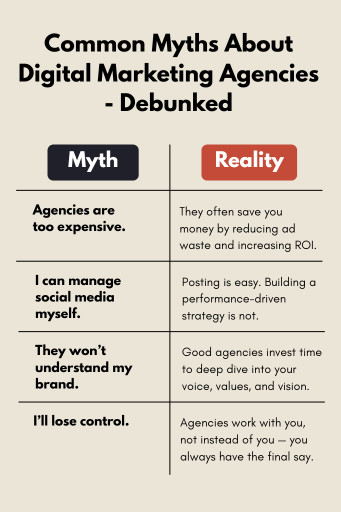
Common Myths About Digital Marketing Agencies Debunked

How to Choose the Right Digital Marketing Partner Here’s a quick checklist to guide your decision:

✅ Do they have experience in your industry?

✅ Can they show case studies or client success stories?

✅ Do they offer tailored strategies or cookie-cutter packages?

✅ Are they transparent about pricing and reporting?

✅ Do they prioritise communication?

Remember, the right agency will feel like an extension of your team, not an outsider.

Your brand has potential. All it needs is the right digital push.

So, are you ready to be seen, heard, and loved online and beyond?

Reach out to Spectadors Digital today. Let’s turn clicks into clients and impressions into impact.